

United Kingdom Leads DHA Self-Tanning Market in Europe with Merck, BASF, and Croda Driving Growth
Rising demand for sunless tanning, regulatory-backed formulations, and e-commerce expansion to drive steady growth through 2036
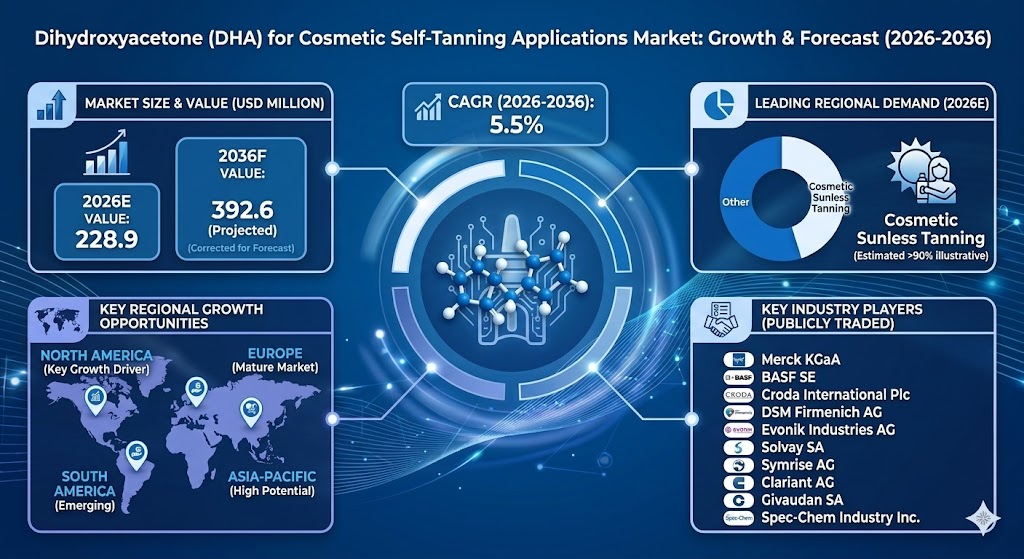
ROCKVILLE, MD, UNITED STATES, April 13, 2026 /EINPresswire.com/ -- According to Fact MR, latest analysis, the United Kingdom Dihydroxyacetone (DHA) for Cosmetic Self-Tanning Applications market is gaining strong traction within the broader global landscape, with the global market valued at USD 228.9 million in 2026 and projected to reach USD 241.5 million in 2027, before expanding to USD 392.6 million by 2036. The market is expected to grow at a CAGR of 5.5%, with the UK outperforming at 5.9% CAGR over the forecast period.Incremental opportunity is estimated at USD 163.7 million between 2026 and 2036, driven by the transition from UV-based tanning to safer, topical alternatives. The UK market is undergoing a transformation fueled by increased consumer awareness, stringent cosmetic regulations, and innovation in formulation chemistry.
Get detailed market forecasts, competitive benchmarking, and pricing trends: https://www.factmr.com/connectus/sample?flag=S&rep_id=14684
Quick Stats Section
Market Size (2026): USD 228.9 million (Global)
Market Size (2027): USD 241.5 million
Forecast Value (2036): USD 392.6 million
CAGR (2026–2036): 5.5% (Global), 5.9% (UK)
Incremental Opportunity: USD 163.7 million
Leading Segment: 5%–10% DHA concentration (~46% share)
Leading Region: Europe (UK leading growth)
Key Players: BASF SE, Croda International Plc, Merck KGaA, DSM Firmenich AG, Evonik Industries AG
Executive Insight for Decision Makers
A structural shift is underway in the UK cosmetic industry, moving from UV-based tanning to science-backed, skin-safe formulations. DHA has emerged as the cornerstone ingredient enabling this transition.
Strategic Imperatives:
Invest in formulation stability and skin compatibility
Strengthen direct-to-consumer and e-commerce channels
Ensure strict regulatory compliance with UK cosmetic standards
Risk of Inaction:
Companies failing to innovate risk losing relevance as consumers increasingly demand safe, predictable, and dermatologically tested products.
Market Dynamics
Key Growth Drivers
Increasing preference for sunless tanning solutions
Expansion of cosmetic product portfolios using DHA
Growth of online retail channels (~37% share)
Rising demand for controlled pigmentation and uniform skin tone
Key Restraints
Regulatory scrutiny on ingredient safety and concentration limits
Higher formulation complexity and production costs
Competition from alternative bronzing technologies
Emerging Trends
Development of multi-format products (drops, serums, wipes)
Focus on clean-label and skin-friendly formulations
Integration of AI-driven product personalization in e-commerce
Increased R&D in color stability and odor reduction
Segment Analysis
Leading Segment:
5%–10% DHA concentration holds ~46% share due to optimal balance between color intensity and formulation stability
Fastest-Growing Segment:
Online retail, driven by consumer convenience and product comparison tools
Breakdown
Product Types: Lotions, sprays, mousses, serums
Application: Personal care, professional salon use
Distribution: Online, specialty retail, supermarkets
Strategic Importance:
Mid-range concentration products dominate due to predictable tanning outcomes and reduced risk of uneven pigmentation, making them ideal for mass-market adoption.
Supply Chain Analysis (VERY IMPORTANT)
Value Chain Overview
Raw Material Suppliers:
Chemical intermediates and carbohydrate derivatives providers
Manufacturers / Producers:
Specialty chemical firms such as BASF, Croda, and Merck produce high-purity DHA
Distributors:
Ingredient distributors and B2B cosmetic supply networks
E-commerce platforms for finished products
End-Users:
Cosmetic brands, personal care companies, dermatology product developers
“Who Supplies Whom”
Chemical companies → supply DHA to → cosmetic manufacturers
Cosmetic manufacturers → develop formulations → supply to retailers/e-commerce
Retailers/e-commerce → deliver products → end consumers
Insight:
The UK benefits from a well-integrated supply chain, where local and European suppliers ensure consistent ingredient quality and regulatory compliance.
Pricing Trends
DHA operates in a semi-specialty chemical pricing model
Pricing varies based on:
Purity levels
Concentration grades
Regulatory compliance certifications
Key Influencers:
Raw material costs
R&D and formulation complexity
Brand positioning (mass vs premium)
Margin Insight:
Ingredient suppliers maintain moderate margins
Cosmetic brands capture higher margins through branding and product differentiation
Regional Analysis (Focus: United Kingdom Leadership)
Top Countries by CAGR (2026–2036)
United Kingdom – 5.9%
Germany – 5.7%
United States – 5.5%
France – 5.3%
Japan – 4.9%
Why the UK Leads
Strong cosmetic regulatory framework
High consumer awareness of UV-related risks
Advanced e-commerce penetration
Presence of leading ingredient manufacturers
Developed vs Emerging Markets
Developed (UK, Germany): Innovation-driven, replacement demand
Emerging: Volume-driven, price-sensitive adoption
Competitive Landscape
Market Structure: Moderately consolidated
Key Players
BASF SE
Croda International Plc
Merck KGaA
DSM Firmenich AG
Evonik Industries AG
Clariant AG
Symrise AG
Givaudan SA
Solvay SA
Competitive Strategies
Product innovation and formulation optimization
Strategic partnerships with cosmetic brands
Expansion of distribution networks
Focus on regulatory compliance and ingredient purity
Strategic Takeaways
For Manufacturers:
Prioritize formulation consistency and product safety
Expand multi-format product offerings
For Investors:
Target companies with strong R&D and regulatory expertise
For Marketers / Distributors:
Leverage digital channels and personalized marketing
Educate consumers on benefits of sunless tanning
Future Outlook
The UK DHA self-tanning market is expected to witness steady, resilient growth through 2036.
Increasing focus on sustainable and skin-safe ingredients
Technological advancements in formulation chemistry
Expansion of direct-to-consumer channels
Long-term opportunity lies in premiumization and personalization of cosmetic products.
Conclusion
The United Kingdom stands at the forefront of the global DHA self-tanning market transformation, driven by regulatory strength, consumer awareness, and innovation. As the industry shifts toward safe, predictable, and high-performance cosmetic solutions, stakeholders who align with these trends will unlock sustained growth and competitive advantage.
Why This Market Matters
The DHA self-tanning market reflects a broader shift in the beauty industry toward health-conscious, science-driven products. In the UK, this evolution is not just a trend—it is a structural transformation shaping the future of personal care.
Unlock 360° insights for strategic decision making and investment planning- https://www.factmr.com/checkout/14684
To View Related Report:
Baby Wipes Market https://www.factmr.com/report/116/baby-wipes-market
Childrenswear Market https://www.factmr.com/report/117/children-wear-market
Cosmetic Wipes Market https://www.factmr.com/report/118/cosmetic-wipes-market
Dishwashing Products Market https://www.factmr.com/report/119/dishwashing-products-market
About Fact.MR
Fact.MR is a global market research and consulting firm, trusted by Fortune 500 companies and emerging businesses for reliable insights and strategic intelligence. With a presence across the U.S., UK, India, and Dubai, we deliver data-driven research and tailored consulting solutions across 30+ industries and 1,000+ markets. Backed by deep expertise and advanced analytics, Fact.MR helps organizations uncover opportunities, reduce risks, and make informed decisions for sustainable growth.
S. N. Jha
Fact.MR
+ +1 628-251-1583
sales@factmr.com
Legal Disclaimer:
EIN Presswire provides this news content "as is" without warranty of any kind. We do not accept any responsibility or liability for the accuracy, content, images, videos, licenses, completeness, legality, or reliability of the information contained in this article. If you have any complaints or copyright issues related to this article, kindly contact the author above.
